Health surveillance in a reference hospital: how Hospital de Sant Pau manages prevention at scale with Sabentis

Occupational health surveillance digitalisation in a hospital is one of the most complex challenges in preventive management in the healthcare sector. Managing check-ups, appointments and follow-ups for a large and diverse workforce is nothing like doing it in a conventional organisation. The profiles are extraordinarily different from each other: clinical, technical, administrative, maintenance and logistics staff. Regulatory requirements are high. And the resources dedicated to prevention, as in most healthcare organisations, are limited relative to the complexity of the challenge.
The Hospital de la Santa Creu i Sant Pau in Barcelona is one of the high-complexity reference centres in Catalonia. With more than 625 years of history and the title of oldest hospital in Spain, it faces that challenge every day. And it has been doing so, for some time now, in a different way.
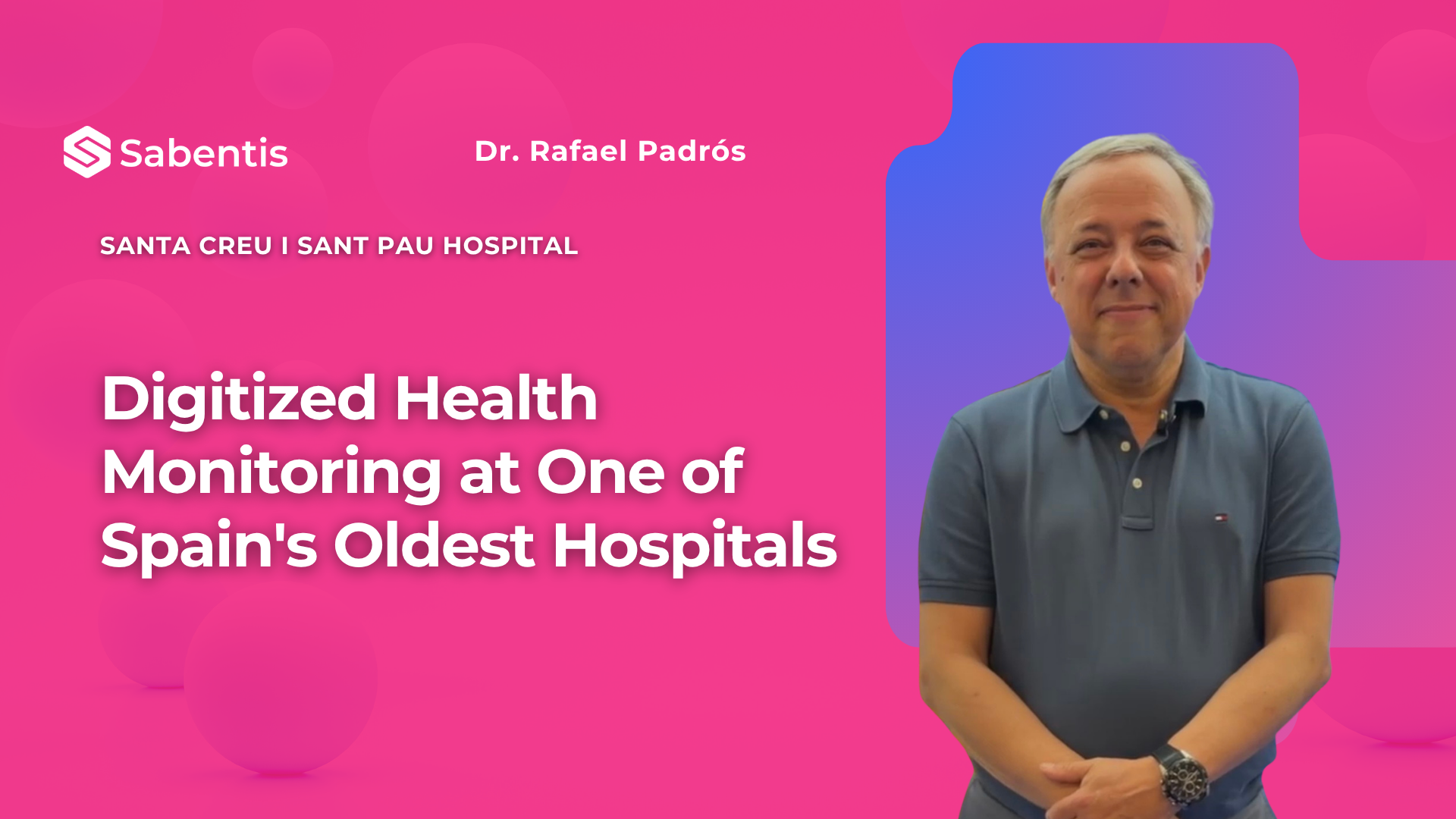
Dr. Rafael Padrós, Head of the Occupational Health and Safety Service at the hospital and speaker at the Round Table Health Surveillance in the Digital Era at LEAN ORP Barcelona 2026, put it clearly: digitalising health surveillance is not just a question of efficiency. It is the difference between managing prevention in a generic way or doing it in an individual, traceable and results-oriented manner.
Health surveillance in a hospital: the challenge of managing at scale
Hospital de Sant Pau is not a conventional workplace. Its workforce is large and diverse, with very different worker profiles, each with their own risks, their own surveillance protocols and their own follow-up needs. Managing that diversity with manual tools or dispersed systems is not just inefficient. It is, in practice, unworkable if the goal is to deliver real prevention rather than merely documentary compliance.
That was the starting point before implementing Sabentis. And that context is what gives meaning to the changes Dr. Padrós describes when he talks about what digitalisation has meant for his prevention service.
Three levels of change: from the immediate to the structural
When asked how preventive management has changed since they started using Sabentis, Dr. Padrós does not give a generic answer. He identifies three levels of change with a precision that reflects years of work on the ground.
The first is immediate and tangible. The organisation of appointments and worker follow-up is much more effective. The service has gained the capacity to schedule appointments, carry out individual follow-ups and attend to workers in a more structured way. A change that seems operational but has direct consequences on the quality of the preventive care each person receives.
The second is structural. Sabentis has allowed them to align with the hospital’s sustainability objectives, reducing paper and other manual management elements that previously consumed resources. In a hospital that has been committed to caring for people for more than six centuries, that alignment is not a minor detail.
The third is the one that will have the greatest long-term impact, although it is still being rolled out. The ability to evaluate both individual and collective results. Seeing not just how each worker is doing, but how the health of the group as a whole evolves. Detecting trends. Making preventive decisions based on real evidence. That is the horizon towards which occupational health surveillance digitalisation points when it is done well.

How digitalising health surveillance changes what is possible in a hospital
There is a second question that very directly summarises the value of digitalisation in an environment like Hospital de Sant Pau. Is there something Sabentis has allowed you to do that was previously impossible or very difficult?
Dr. Padrós’s answer is clear and direct: working with large groups of workers. It was previously very difficult to manage periodic check-ups at scale. Sabentis has allowed them to schedule individually, personalise health surveillance and carry out follow-up more tailored to each person within a large group.
That is exactly what separates real health surveillance from documentary health surveillance. It is not about having records up to date. It is about ensuring each worker receives the attention that corresponds to their profile, their risks and their history. And about the prevention service being able to guarantee that at scale, without volume becoming an obstacle to quality.
Health surveillance in the digital era: from data to real care
The Hospital de Sant Pau case illustrates precisely the challenge any large healthcare organisation faces in terms of prevention. Many workers, very different profiles, high regulatory requirements and limited resources. Digitalisation does not solve that challenge on its own. But when implemented well, it radically changes what is possible.
An HSE Platform like Sabentis makes it possible to centralise health surveillance in a single environment, link protocols to the risks of each role, manage appointments and follow-up individually and generate the traceability the regulation requires and that an audit can verify. All connected to the rest of the preventive processes: risk assessments, training, incidents and corrective measures.
The result, as Dr. Padrós describes, is not just efficiency. It is the ability to do something that was previously unworkable at that scale: personalise health surveillance for each worker within a high-complexity organisation. And do it systematically, traceably and oriented towards real results.
Because occupational risk prevention in a hospital is not an administrative process. It is a responsibility towards the people who care for other people.
Want to see how Sabentis can help you transform health surveillance in your organisation? Request a demo.